

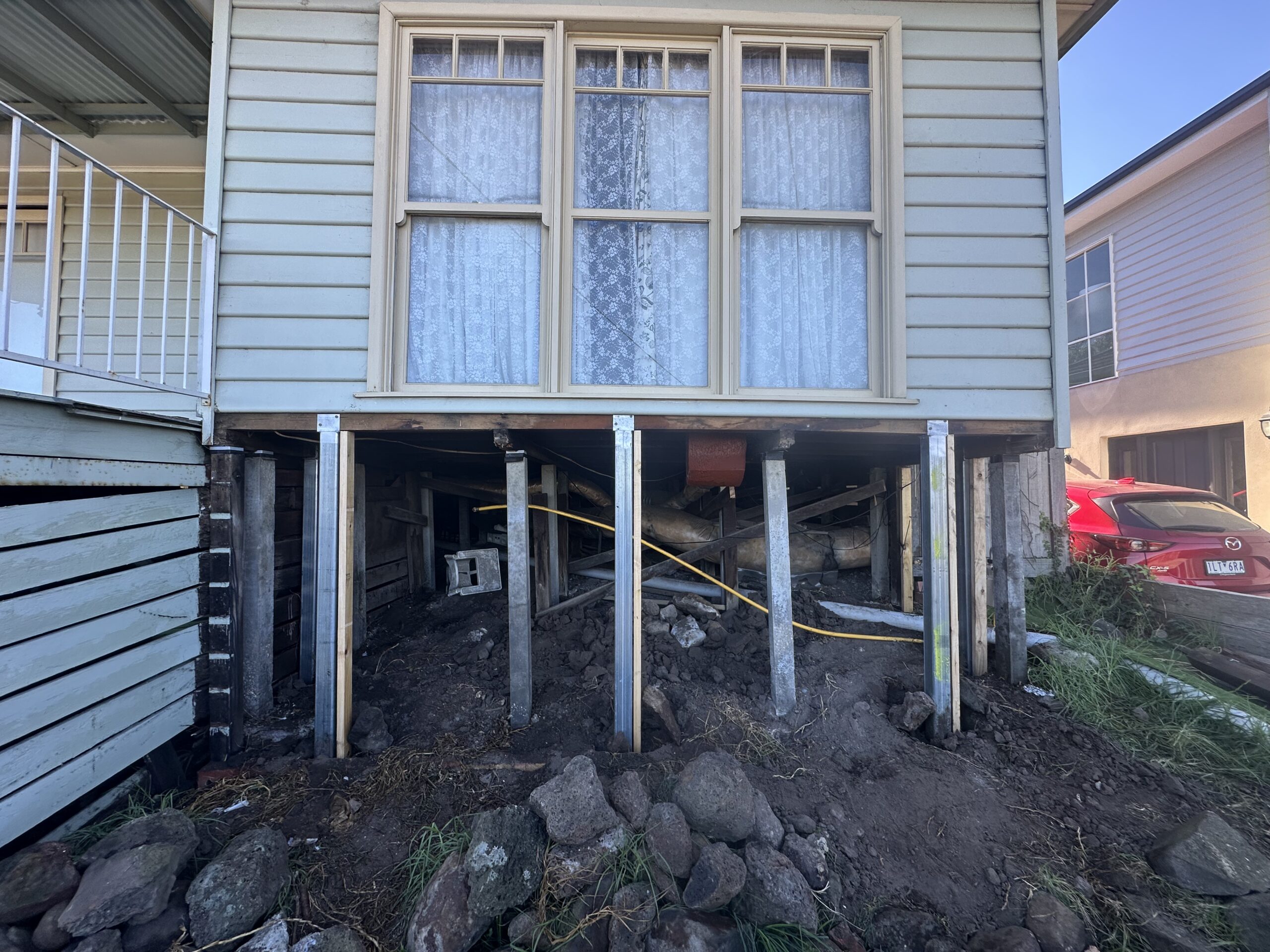
Homeowners dealing with foundation problems are frequently told they need either reblocking or restumping. The terms are often used interchangeably, but they are not the same solution.
Understanding the difference matters because choosing the wrong approach can lead to incomplete repairs, recurring movement, and unnecessary cost.
Both methods aim to stabilise a house. How they do it, and when they are appropriate, differs significantly.
What Is Restumping?
Restumping refers to replacing or repairing individual stumps that support a house.
This approach is typically used when existing stumps have deteriorated but the overall structure remains relatively level. Older homes with timber stumps commonly require restumping when rot, moisture damage, or age reduces load-bearing capacity.
Restumping focuses on the condition of the stumps themselves, not on correcting broader structural movement.
What Is Reblocking?
Reblocking is a more comprehensive structural solution.
It involves lifting the house, replacing or installing new stumps, and re-levelling the entire structure. The goal is not just to support the house, but to restore correct alignment and weight distribution across the foundation.
Reblocking is usually required when uneven floors, widespread cracking, or long-term house movement is present. It addresses both support failure and structural misalignment.
Key Differences Between Reblocking and Restumping
The simplest way to understand the difference is scope.
Restumping is targeted. It fixes specific supports that have failed.
Reblocking is holistic. It corrects the structure as a system.
If floors are sloping, doors are misaligned throughout the house, or cracking appears across multiple areas, reblocking is usually the appropriate solution. If issues are isolated and structural levels are largely intact, restumping may be sufficient.
Which Option Does Your Home Need?
The correct solution depends on three factors: the extent of movement, the condition of existing stumps, and the underlying soil behaviour.
Homes showing consistent movement patterns across multiple rooms rarely benefit from partial repairs. In these cases, reblocking provides long-term stability and prevents recurring issues.
Homes with localised stump failure and minimal structural distortion may be suitable for restumping.
A professional assessment determines whether the issue is isolated or systemic.
Cost Considerations and Long-Term Value
Restumping is generally less expensive upfront, but it can become costly if underlying movement continues and further repairs are required.
Reblocking has a higher initial cost but delivers a full structural reset. When foundation problems are widespread, reblocking often proves more cost-effective over the life of the home.
Choosing based on price alone is a common mistake. The correct solution is the one that stops movement, not the one that delays it.
Why Correct Diagnosis Matters
Many foundation issues worsen when only symptoms are treated.
Reblocking and restumping are tools, not interchangeable fixes. Applying the wrong one can mask problems temporarily while structural stress continues unseen.
Clear diagnosis protects both the structure and the homeowner’s investment.
Final Thought
If your home is showing signs of foundation movement, understanding the difference between reblocking and restumping is critical.
The right solution restores stability, prevents future damage, and protects property value. The wrong one simply postpones the problem.