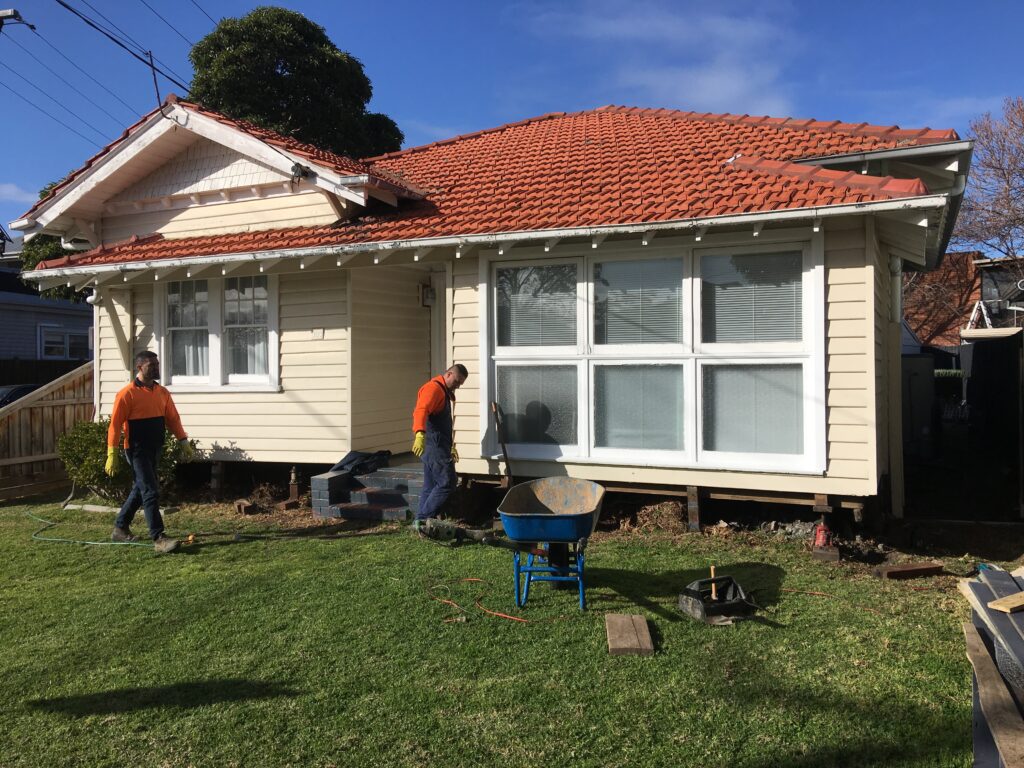
Both materials can provide durable structural support when they are correctly selected, designed and installed. The better option depends on the property, ground conditions, access beneath the home, engineering requirements and the scope of the restumping work.
Rather than assuming one material is always superior, it is more useful to understand how concrete and steel stumps differ and what should be considered when replacing ageing supports.
Why Are Old House Stumps Replaced?
Many older Melbourne homes were originally constructed on timber stumps. Over time, timber can deteriorate because of age, moisture conditions, rot, termite activity or movement in the surrounding ground.
As supports weaken or move, homeowners may begin noticing symptoms such as uneven floors, recurring cracks, sticking doors or gaps around frames.
If these symptoms sound familiar, our guide to uneven floors in Melbourne homes explains some of the common causes.
Where the existing supports can no longer adequately support the structure, replacement may form part of a professional restumping or house reblocking project.
Concrete vs Steel Stumps: What’s the Difference?
Concrete Stumps
Concrete stumps are widely used as replacement supports beneath homes. They do not rot or provide a food source for termites and can provide long-term structural support when correctly specified and installed.
- Not susceptible to timber rot
- Not a food source for termites
- Commonly used for residential stump replacement
- Suitable for many traditional subfloor applications
- Heavier to handle during installation
Steel Stumps
Steel stumps offer strong structural support with a relatively compact section. Their suitability depends on the design, installation method and appropriate protection from corrosion.
- Strong structural support
- Compact profile can be useful where access is limited
- Not vulnerable to termite attack or timber rot
- Can suit a range of foundation configurations
- Appropriate corrosion protection is important
Are Concrete Stumps Better for Termite Resistance?
Concrete itself does not provide a food source for termites, which is one reason it is commonly considered when replacing older timber supports.
Steel is also not susceptible to termite consumption. However, replacing timber stumps with either concrete or steel does not make the entire property termite-proof. Timber floor framing and other structural components can still be vulnerable.
Termite management therefore needs to be considered across the property rather than relying solely on the material used for the new stumps.
What About Moisture and Corrosion?
Moisture conditions beneath a house are important regardless of the stump material.
Steel needs suitable corrosion protection, particularly where environmental conditions could contribute to rust. Concrete is not affected by corrosion in the same way as exposed steel, although reinforced concrete can still deteriorate if moisture reaches reinforcement or the material becomes damaged.
Drainage and moisture around the foundations also influence ground movement, which means the surrounding site conditions should be considered as part of the broader repair rather than focusing only on the stump material.
Which Is Easier to Install?
Installation depends heavily on access beneath the property.
Concrete stumps are relatively heavy, which can make handling more difficult in areas with restricted crawl-space access. Steel supports can offer a more compact alternative in some situations.
However, convenience alone should not determine the material. The replacement supports still need to suit the structural requirements of the home and the conditions beneath the property.
Does the Stump Material Affect Restumping Cost?
It can, but material choice is only one part of the overall project cost.
The number of stumps being replaced, access beneath the home, excavation requirements, amount of structural movement and level correction can have a significant influence on the final quote.
For a more complete breakdown, read our Restumping Cost Melbourne guide.
If the property also requires substantial correction to uneven floors, our House Levelling Cost Melbourne guide explains the factors that can affect that part of the work.
Concrete or Steel Stumps: Which Lasts Longer?
There is no useful universal lifespan that applies to every concrete or steel stump.
Long-term performance depends on factors including material quality, installation, drainage, soil conditions, corrosion protection, structural loading and ongoing conditions beneath the property.
For that reason, choosing between concrete and steel should be based on the requirements of the individual home rather than a simple claim that one material always lasts longer.
The key point: the best stump is not simply the strongest-looking material. It is the support that is suitable for the property’s structural requirements, foundation conditions and installation environment.
Do All Stumps Need to Be Replaced?
Not necessarily.
A property may have localised deterioration affecting only part of the subfloor, while another home may have widespread ageing or movement across many supports.
An inspection helps determine the condition of the existing stumps, whether partial or more extensive replacement is appropriate and whether additional house levelling is required.
Visible symptoms alone do not always reveal the full condition beneath the property. Recurring cracks and uneven floors, for example, can be associated with several different foundation issues.
So, Which Is Better: Concrete or Steel Stumps?
For Melbourne homeowners, there is no single answer that applies to every property.
Concrete stumps can provide durable, termite-resistant support and are widely used in residential restumping. Steel stumps can also provide strong, durable support and may offer advantages where their profile or installation characteristics suit the project, provided corrosion protection and other design requirements are addressed.
The correct choice should ultimately be based on the home, existing foundation system, site conditions and required structural solution.
Planning to Restump Your Melbourne Home?
If your existing stumps are deteriorating or your floors are becoming uneven, First Choice Reblocking can inspect the property and determine the appropriate replacement and foundation repair options.
Learn more about our Restumping Melbourne services or arrange an inspection before deciding between concrete and steel stumps.